
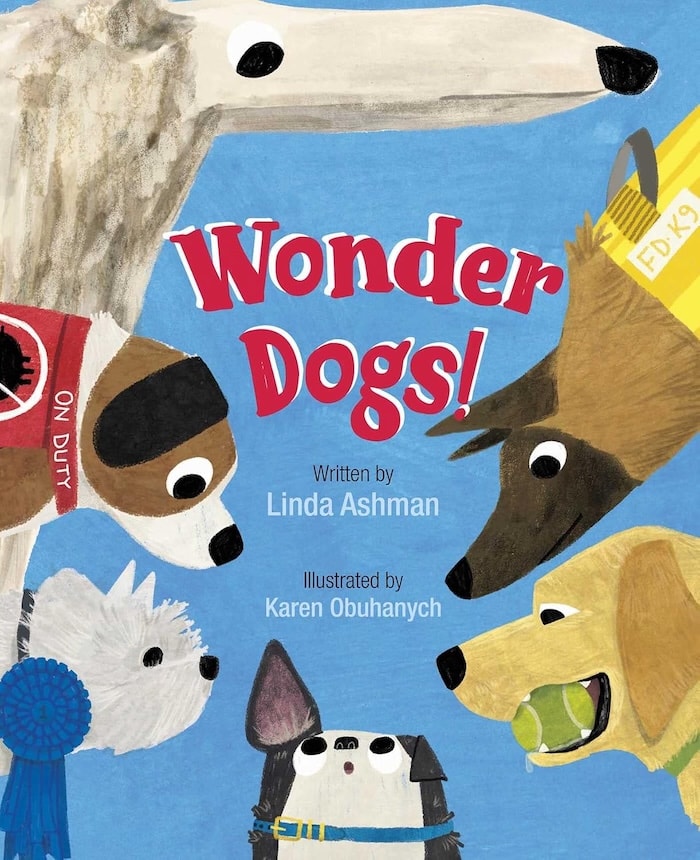
Wonder Dogs!
Written by Linda Ashman
Illustrated by Karen Obuhanych
From search-and-rescue dogs to guide dogs, therapy dogs to detection dogs, this lively nonfiction picture book celebrates the remarkable ways dogs work alongside humans. With bouncy verse and vibrant illustrations, it introduces young readers to the many jobs dogs do — and the special bond between dogs and the people they help.
From the Library Director
Linda Ashman's bouncy, read-aloud verse makes this a natural storytime pick, and Karen Obuhanych's illustrations are full of energy and warmth. It's a great entry point for nonfiction discussions — kids are immediately engaged because they love dogs, and before they know it they're learning about careers, animal training, and the science of scent. Pairs beautifully with a 'jobs in the community' unit or any animal-themed collection.
Big Idea
Dogs aren't just pets — they're partners, helpers, and heroes, and the bond between a dog and a person can change both their lives.
Discussion Questions
- 1
What are some of the different jobs that wonder dogs do? Which one surprised you the most?
- 2
How do you think dogs are trained to do such important jobs? What qualities do you think a wonder dog needs?
- 3
How do the dogs in this book help people? How do you think the people feel about their dogs?
- 4
The book is written in verse — rhyming lines with a rhythm. How does that make it feel different from a regular nonfiction book? Did it make it more fun to read?
- 5
Guide dogs help people who can't see, and therapy dogs help people who are feeling sad or scared. How are those two jobs similar? How are they different?
- 6
If you could train a dog to do any job, what would it be and why?
- 7
Dogs use their noses in ways humans can't. What does that tell us about how different animals experience the world?
- 8
What does the word 'wonder' mean in the title? Do you think it means more than one thing?
Activity: Design a Wonder Dog
Students choose a real or imaginary job for a dog, design their wonder dog, and write about the important work it does — combining nonfiction research skills with creative expression.
- 1
Choose one type of wonder dog from the book — or research a dog job not mentioned (like a truffle-hunting dog or a movie dog). Write down two facts about what that dog does.
- 2
Draw your wonder dog. Give it a name, a breed (or mix!), and show it doing its job. Add a label or caption explaining what it's doing.
- 3
Write 2–3 sentences: What is your dog's name? What job does it do? Why is that job important?
- 4
Share your wonder dog with the class. As a group, create a 'Wonder Dogs Hall of Fame' display with everyone's designs.
Standards Connections
CCSS.ELA-LITERACY.RI.K.1 — With prompting and support, ask and answer questions about key details in a text.
CCSS.ELA-LITERACY.RI.2.3 — Describe the connection between a series of historical events, scientific ideas or concepts, or steps in technical procedures in a text.
CCSS.ELA-LITERACY.W.1.2 — Write informative/explanatory texts in which they name a topic, supply some facts about the topic, and provide some sense of closure.
CCSS.ELA-LITERACY.RF.1.4 — Read with sufficient accuracy and fluency to support comprehension.
Social-Emotional Learning — Develop empathy and appreciation for helpers in the community, including working animals.
Science/NGSS — Explore how animals use their senses and how humans and animals can work together.
Ready to use this guide in your classroom?
Download the printable PDF with all questions and activities.