
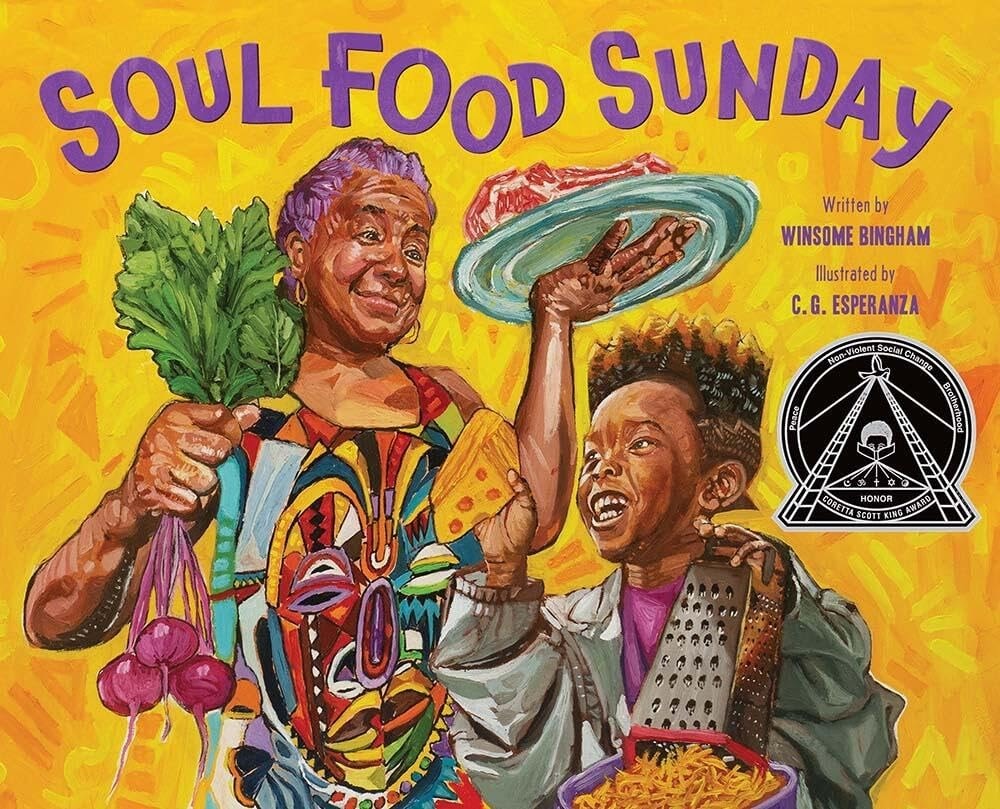
Soul Food Sunday
Written by Winsome Bingham
Illustrated by C.G. Esperanza
Every Sunday, a young boy and his grandmother cook together — stirring, seasoning, and sharing the soul food recipes that have been passed down through their family for generations. Rich with love, memory, and the smells of a kitchen full of warmth, this lyrical picture book celebrates Black family traditions, the power of food to connect us across time, and the joy of learning from the people we love most.
From the Library Director
This is a gorgeous, sensory book — you can almost smell the cornbread and collard greens. Bingham's text is lyrical and warm, and Esperanza's illustrations are rich with color and emotion. It's a wonderful anchor for conversations about family traditions, cultural heritage, and the ways food connects generations. It also works beautifully as a mentor text for descriptive writing — the sensory language is exceptional. A natural fit for Black History Month, family unit studies, or any time you want to celebrate the diversity of family traditions in your community.
Big Idea
Food is more than a meal — it carries memory, love, and identity, and the recipes we share with family are a way of keeping our history alive.
Discussion Questions
- 1
What is soul food? Where does it come from, and why is it important to the family in this story?
- 2
The boy learns recipes from his grandmother. What do you think he is learning beyond just how to cook?
- 3
Does your family have a special food or meal you make together? What does it mean to you?
- 4
How does the author use your senses — smell, taste, sight, sound — to bring the kitchen to life? Find a line that made you feel like you were really there.
- 5
Why do you think Sunday is the special day for this family? What makes a day feel special?
- 6
The grandmother passes down recipes that have been in the family for generations. Why is it important to keep traditions alive? What might be lost if they were forgotten?
- 7
How do the illustrations show the relationship between the boy and his grandmother? What details did you notice?
- 8
If you could add one dish to the family's Sunday table, what would it be and why?
Activity: My Family Recipe Story
Students connect the book's themes of food, memory, and tradition to their own lives by writing and illustrating a family recipe story — practicing descriptive writing, personal narrative, and cultural appreciation.
- 1
Think of a food your family makes that is special to you — a holiday dish, a comfort food, or something a grandparent or parent makes. If you can, ask a family member to tell you the story behind it. Where did the recipe come from? Who taught them?
- 2
Write a short paragraph describing the food using your senses: What does it look like? What does it smell like when it's cooking? What does it taste like? Use vivid, specific words — just like Winsome Bingham does in the book.
- 3
Draw a picture of your family making or eating this food together. Try to capture the feeling of the moment — the warmth, the people, the setting.
- 4
Share your recipe story with the class. As a group, create a 'Class Recipe Book' that celebrates the different food traditions in your community.
Standards Connections
CCSS.ELA-LITERACY.RL.K.3 — With prompting and support, identify characters, settings, and major events in a story.
CCSS.ELA-LITERACY.RL.2.6 — Acknowledge differences in the points of view of characters, including by speaking in a different voice for each character when reading dialogue aloud.
CCSS.ELA-LITERACY.W.2.3 — Write narratives in which they recount a well-elaborated event or short sequence of events, include details to describe actions, thoughts, and feelings.
CCSS.ELA-LITERACY.SL.1.4 — Describe people, places, things, and events with relevant details, expressing ideas and feelings clearly.
Social Studies — Culture and Cultural Diversity: Understand how food, traditions, and family practices reflect cultural identity and heritage.
Social-Emotional Learning — Family connections, intergenerational relationships, and appreciation for diverse cultural traditions.
Ready to use this guide in your classroom?
Download the printable PDF with all questions and activities.