
Coming Soon — releases October 13, 2026. Guide is ready now so you can plan ahead.
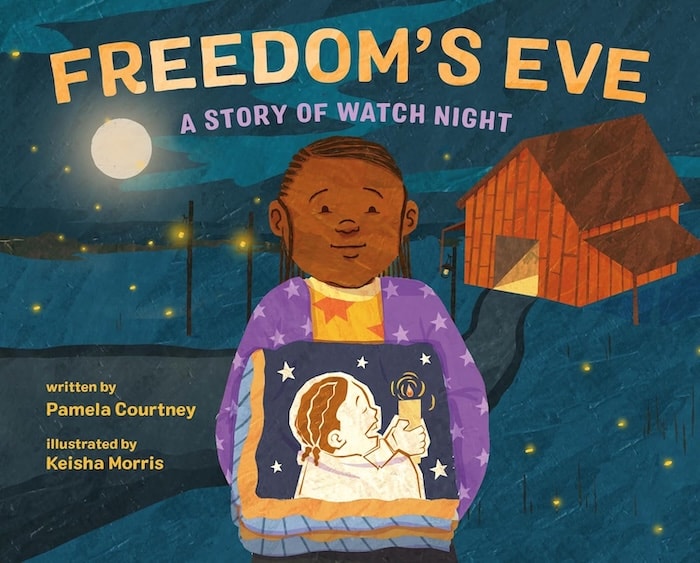
Freedom's Eve: A Story of Watch Night
Written by Pamela Courtney
On the last night of 1862, enslaved people across the South gathered in churches and fields to wait and pray — counting down the hours until the Emancipation Proclamation would take effect at midnight on January 1, 1863. This is the story of Watch Night: a vigil of hope, faith, and the long-awaited promise of freedom. Pamela Courtney brings this powerful and often overlooked piece of American history to life for young readers.
From the Library Director
Watch Night is one of those pieces of American history that doesn't get nearly enough attention in elementary classrooms, and this book is a beautiful way to bring it in. It's a story about waiting — about what it feels like to be on the edge of something enormous — and kids connect to that in a profound way. It pairs naturally with units on the Civil War, the Emancipation Proclamation, and African American history, but it also stands alone as a story about hope and community. A powerful read-aloud for any time of year, and especially meaningful around New Year's and Black History Month.
Big Idea
Freedom is worth waiting for — and the people who waited through that long night of December 31, 1862 showed the world what hope, faith, and courage look like.
Discussion Questions
- 1
What is Watch Night? Why did enslaved people gather together on the night of December 31, 1862?
- 2
What is the Emancipation Proclamation? What did it promise, and why did it matter so much to the people waiting that night?
- 3
Imagine waiting all night for something that would change your life forever. What do you think the people in the story were feeling as midnight approached?
- 4
Why do you think the author chose to tell this story from the perspective of a child? How does that change the way you experience the events?
- 5
The people gathered in churches and fields to wait together. Why do you think being together as a community was important on that night?
- 6
The Emancipation Proclamation was a beginning, not an end. What challenges did formerly enslaved people still face after January 1, 1863?
- 7
Many African American churches still hold Watch Night services today. Why do you think this tradition has been kept alive for more than 160 years?
- 8
What does this story teach us about hope? Can you think of a time when you or someone you know had to wait and hope for something important?
Activity: Counting Down to Freedom: A Timeline of Hope
Students build historical context and practice sequencing skills by creating a timeline of key events leading up to and following the Emancipation Proclamation — connecting the Watch Night story to the broader arc of American history.
- 1
As a class, discuss: What was happening in America in 1862? Create a brief shared timeline on the board with key events: the start of the Civil War (1861), Lincoln's preliminary Emancipation Proclamation (September 1862), Watch Night (December 31, 1862), and the Emancipation Proclamation taking effect (January 1, 1863).
- 2
On your own timeline strip, add at least four events from the book or your research. For each event, write: the date, what happened, and one word that describes how the people involved might have felt.
- 3
Write a short journal entry from the perspective of someone waiting at a Watch Night gathering. What do you see, hear, and feel? What are you hoping for? What are you afraid of?
- 4
Discuss as a class: Why is it important to learn about Watch Night? What might be lost if this story were forgotten? How can we make sure history like this is remembered?
Standards Connections
CCSS.ELA-LITERACY.RI.3.3 — Describe the relationship between a series of historical events, scientific ideas or concepts, or steps in technical procedures in a text.
CCSS.ELA-LITERACY.RL.3.6 — Distinguish their own point of view from that of the narrator or those of the characters.
CCSS.ELA-LITERACY.W.3.3 — Write narratives to develop real or imagined experiences or events using effective technique, descriptive details, and clear event sequences.
CCSS.ELA-LITERACY.RI.4.3 — Explain events, procedures, ideas, or concepts in a historical, scientific, or technical text, including what happened and why, based on specific information in the text.
Social Studies — U.S. History: Civil War era, the Emancipation Proclamation, and the experiences of enslaved people in America.
Social Studies — Culture and Traditions: Understand how historical events shape cultural practices and community traditions that persist across generations.
Ready to use this guide in your classroom?
Download the printable PDF with all questions and activities.