
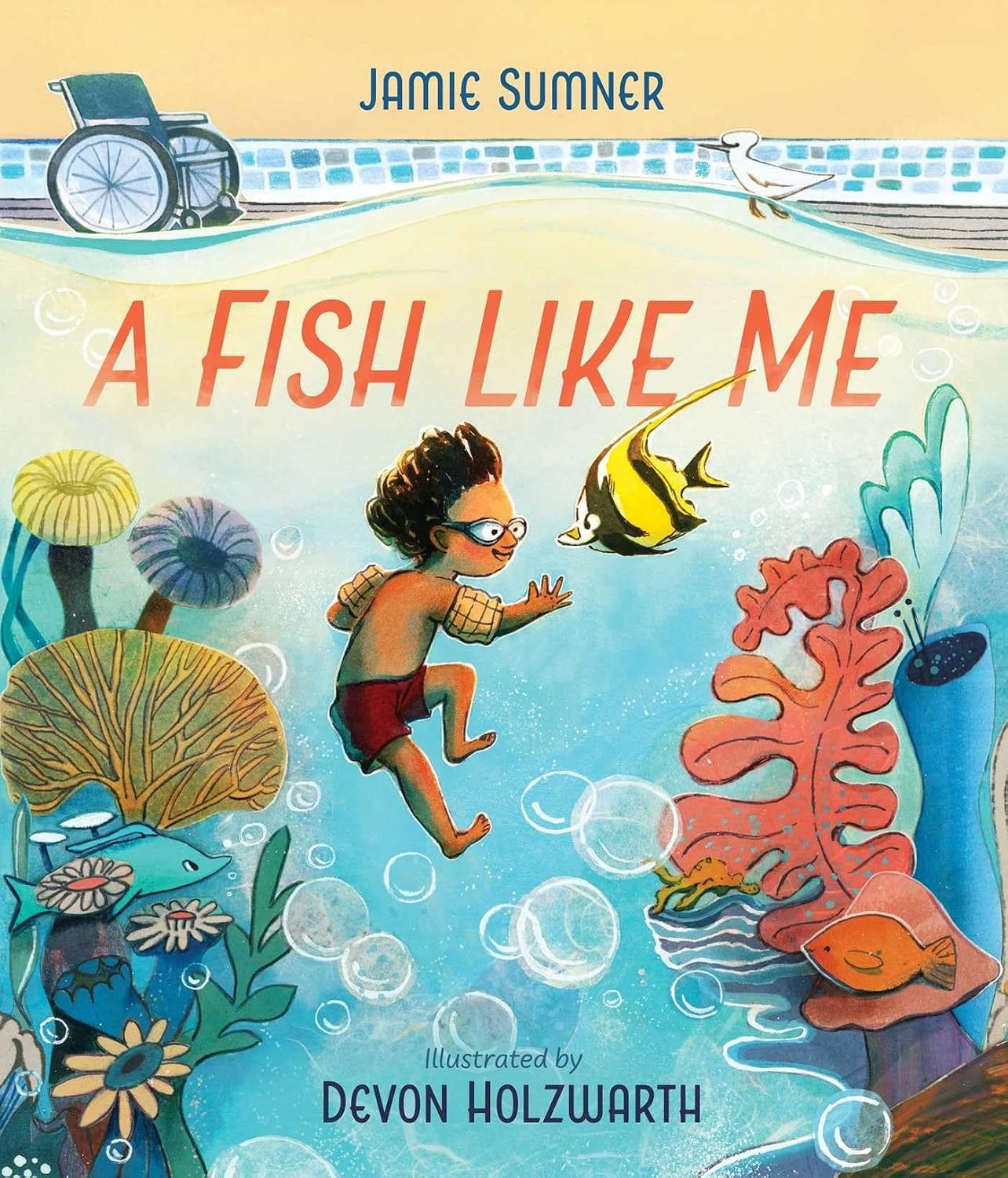
A Fish Like Me
Written by Jamie Sumner
Illustrated by Gillian Reid
When a little girl who uses a wheelchair visits the aquarium, she discovers a fish who moves differently than all the others — and feels an instant, wordless connection. A Fish Like Me is a tender, beautifully observed story about finding yourself reflected in the world, the quiet power of belonging, and the way difference can become a source of wonder rather than worry.
From the Library Director
Jamie Sumner writes about disability with such warmth and specificity — this never feels like a 'lesson book,' it feels like a real story about a real child having a real moment of recognition. The aquarium setting is inspired: it gives the book a sense of wonder and discovery that lifts the whole thing. Gillian Reid's illustrations are luminous and full of feeling. I've used this with K–3 and it works beautifully across that whole range — younger kids respond to the emotional core, older kids can go deeper on questions of identity and representation. It's also a wonderful book for classrooms that include students with physical disabilities, because it centers the child's inner life and joy rather than her limitations.
Big Idea
Everyone deserves to see themselves in the world — and when we look closely, we find that difference is everywhere, and it is beautiful.
Discussion Questions
- 1
Why do you think the girl felt such a strong connection to the fish? What did they have in common?
- 2
Have you ever seen something — an animal, a character in a book, a person — and felt like they were 'like you' in some way? What did that feel like?
- 3
The fish moves differently than the other fish. How do the other fish treat it? How does the aquarium feel about it?
- 4
What does it mean to 'belong' somewhere? What makes a place feel welcoming or unwelcoming?
- 5
The girl uses a wheelchair. How does the author show her experience without making her disability the only thing about her?
- 6
Why is it important for children to see characters in books who look like them or experience the world the way they do?
- 7
How do the illustrations help tell the story? Find a page where the picture adds something the words don't say.
- 8
If you were going to write a story about finding something in the world that felt 'like you,' what would it be? Where would you find it?
Activity: A Creature Like Me
Students explore identity, representation, and the natural world by finding or inventing an animal whose traits, adaptations, or way of moving through the world reflects something true about themselves — then writing and illustrating their own 'A _____ Like Me' page.
- 1
Think about yourself: How do you move through the world? What are you good at? What makes you different from others around you? What do you love? Write down three to five things that feel true and specific about you.
- 2
Now think about animals. Is there a creature — real or imagined — whose traits, adaptations, or way of being in the world connects to something on your list? It doesn't have to be an exact match. Maybe you're both fast, or both quiet, or both most alive in the water, or both misunderstood. Choose your animal.
- 3
Write your own 'A _____ Like Me' page. Describe your animal and the connection you feel to it. Use specific, sensory language — what does it look like, how does it move, what does it feel like to be that creature? Then write one sentence about what it means to you to have found it.
- 4
Illustrate your page in the style of Gillian Reid — luminous, close, full of feeling. Share with the class. Discuss: What surprised you about the connections people found? What does it tell us about how we see ourselves?
Standards Connections
CCSS.ELA-LITERACY.RL.1.3 — Describe characters, settings, and major events in a story, using key details.
CCSS.ELA-LITERACY.RL.2.6 — Acknowledge differences in the points of view of characters, including by speaking in a different voice for each character when reading dialogue aloud.
CCSS.ELA-LITERACY.W.2.3 — Write narratives in which they recount a well-elaborated event or short sequence of events, include details to describe actions, thoughts, and feelings.
CCSS.ELA-LITERACY.SL.1.4 — Describe people, places, things, and events with relevant details, expressing ideas and feelings clearly.
Social-Emotional Learning — Identity and belonging: developing self-awareness, recognizing and respecting difference, and building empathy for others' experiences.
Representation in Literature — Understanding why diverse representation matters and how authors and illustrators make choices that include or exclude readers.
Ready to use this guide in your classroom?
Download the printable PDF with all questions and activities.