
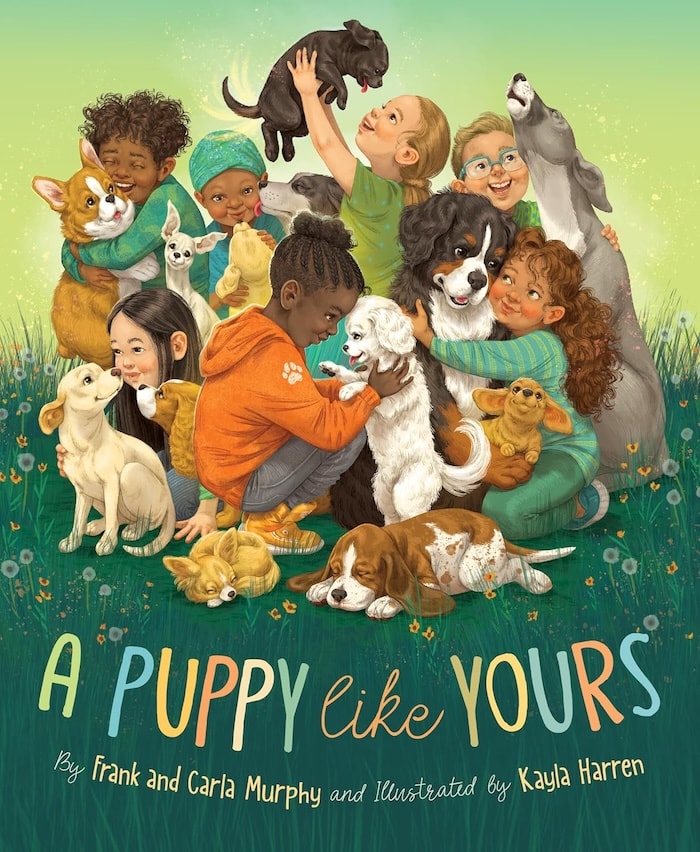
A Puppy Like Yours
Written by Frank and Carla Murphy
Illustrated by Vivien Mildenberger
A little girl desperately wants a puppy — and when she finally gets one, she discovers that loving a pet means so much more than cuddles and playtime. A Puppy Like Yours is a warm, funny, and honest story about the joys and responsibilities of caring for a new animal companion, told with heart by the husband-and-wife team of Frank and Carla Murphy.
From the Library Director
Frank and Carla Murphy have a wonderful gift for writing books that feel true to how kids actually experience things — the longing, the excitement, the reality check, and then the deeper joy on the other side of it. This one is perfect for K–2 because it meets kids exactly where they are: most of them either have a pet, want a pet, or have a friend with a pet, and they all have feelings about it. Vivien Mildenberger's illustrations are expressive and warm. It's a great read-aloud for conversations about responsibility, empathy, and what it means to take care of something that depends on you. Also just genuinely fun — the puppy chaos scenes are delightful.
Big Idea
Caring for a pet is one of the first big responsibilities many children take on — and it teaches us that real love means showing up, even when it's hard.
Discussion Questions
- 1
Why did the girl want a puppy so much? Have you ever wanted something really badly? What did that feel like?
- 2
What were some of the fun parts of having a puppy? What were some of the hard parts?
- 3
What does it mean to be responsible for something? What responsibilities did the girl have for her puppy?
- 4
Do you have a pet, or has someone you know had a pet? What kinds of things did they need to do to take care of it?
- 5
The puppy couldn't tell the girl what it needed — it could only show her. How did she figure out what it needed? What clues did she use?
- 6
How did the girl's feelings about having a puppy change from the beginning of the story to the end? What changed for her?
- 7
What do you think the puppy was feeling at different points in the story? How do you know?
- 8
If you could have any pet, what would you choose? What would you need to do to take care of it?
Activity: My Pet Care Plan
Students practice real-world responsibility thinking by creating a detailed care plan for a pet — real or imagined — building empathy, planning skills, and an understanding of what it means to be accountable for another living thing.
- 1
Choose a pet — your own, a friend's, or one you'd love to have someday. It can be a dog, cat, fish, hamster, lizard, horse, or anything else. Write its name (or give it one) and draw a picture of it at the top of your page.
- 2
Create your care plan. Think about: What does your pet eat, and how often? Where does it sleep? How does it exercise or play? What does it need to stay healthy? What does it need when it's scared or lonely? Write at least one answer for each category.
- 3
Now think about the hard parts. What is one thing about caring for this pet that would be difficult or not fun? How would you handle it? Write a sentence or two about what you would do when caring for your pet is tough.
- 4
Share your care plan with the class. Discuss: What surprised you about how much work goes into caring for a pet? What do you think is the most important part of being a good pet owner? What does this have in common with caring for people?
Standards Connections
CCSS.ELA-LITERACY.RL.K.3 — With prompting and support, identify characters, settings, and major events in a story.
CCSS.ELA-LITERACY.RL.1.3 — Describe characters, settings, and major events in a story, using key details.
CCSS.ELA-LITERACY.W.1.3 — Write narratives in which they recount two or more appropriately sequenced events, include some details regarding what happened, use temporal words to signal event order, and provide some sense of closure.
CCSS.ELA-LITERACY.SL.K.4 — Describe familiar people, places, things, and events and, with prompting and support, provide additional detail.
Social-Emotional Learning — Responsibility and self-management: understanding what it means to be accountable for the needs of another living thing.
Science — Life Science: basic needs of animals; how animals communicate needs; animal behavior and care.
Ready to use this guide in your classroom?
Download the printable PDF with all questions and activities.