
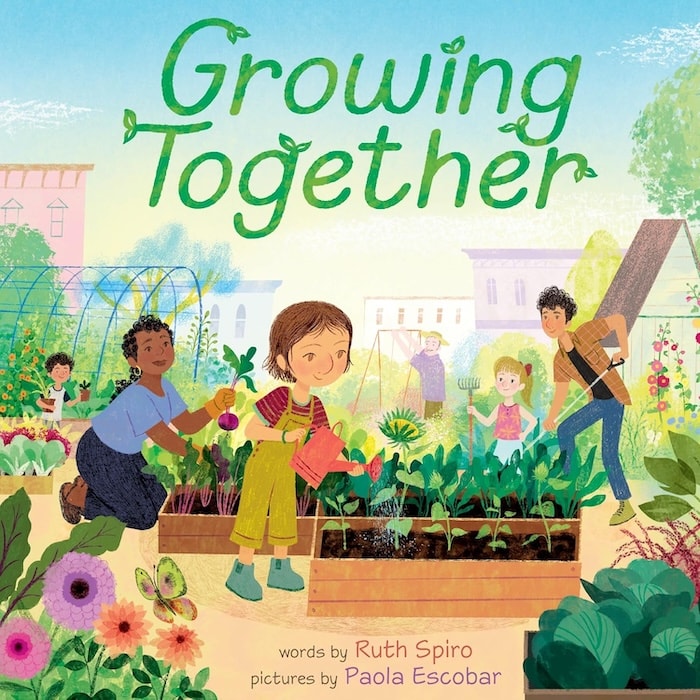
Growing Together
Written by Ruth Spiro
Illustrated by Tania de Regil
A young child and their grandfather share a special bond through the seasons — tending a garden, watching things grow, and learning that some of the most important things in life take time and patience. Growing Together is a tender, lyrical celebration of intergenerational connection, the rhythms of nature, and the quiet wisdom that passes between generations when we slow down and pay attention.
From the Library Director
Ruth Spiro has a gift for writing books that feel genuinely quiet and unhurried in the best possible way — this one asks kids to slow down and notice, which is a rare and valuable thing. The grandfather-grandchild relationship at the center of it is warm and specific without being sentimental. Tania de Regil's illustrations are gorgeous: rich, earthy, full of texture and seasonal detail. I've used this with K–3 and it works beautifully as a read-aloud for any unit on family, seasons, or plants — but it's also just a wonderful standalone book for sparking conversation about the people in kids' lives who teach them things without making it feel like a lesson. The gardening metaphor runs all the way through and kids really respond to it.
Big Idea
The relationships we tend with care — like a garden — grow into something that nourishes us for a lifetime.
Discussion Questions
- 1
What did the child and grandfather do together in the garden? What did each of them bring to the work?
- 2
Why do you think the author chose a garden as the setting for this story? What does a garden have in common with a relationship?
- 3
Is there an older person in your life — a grandparent, neighbor, or family friend — who has taught you something? What did you learn from them?
- 4
The story follows the seasons. How did the garden change through the year? How did the relationship between the child and grandfather change too?
- 5
What does it mean to be patient? Can you think of something in your life that required patience before it was ready?
- 6
The grandfather knows a lot about growing things. How does he share that knowledge with the child? What is the difference between being told something and learning it by doing it?
- 7
How do the illustrations show the passing of time and the changing seasons? Find a page where the art tells you something the words don't say.
- 8
If you could grow something — a plant, a skill, a friendship — what would you choose? What would you need to do to help it grow?
Activity: My Growing Together Interview
Students connect with an older person in their life — a grandparent, family member, neighbor, or community elder — to learn something that can only be passed down through conversation and relationship. Then they share what they discovered with the class.
- 1
Think of an older person in your life whose knowledge or experience you admire. This could be a grandparent, a great-aunt or uncle, a neighbor, a family friend, or anyone older who knows something you'd like to learn. Write their name and your relationship to them.
- 2
Prepare three to five questions to ask them. Think about: What is something they know how to do that most people your age don't? What was life like when they were your age? What is the most important thing they've learned? Is there something they wish they had known when they were young? What do they want you to remember?
- 3
Conduct your interview — in person, by phone, or by video call. Take notes or, with permission, record it. Listen carefully. Ask follow-up questions. Notice what surprises you.
- 4
Write a one-page reflection: What did you learn? What surprised you? What do you want to remember from this conversation? Share with the class. Discuss: What kinds of knowledge can only be passed down through relationships? What would be lost if we stopped asking?
Standards Connections
CCSS.ELA-LITERACY.RL.1.3 — Describe characters, settings, and major events in a story, using key details.
CCSS.ELA-LITERACY.RL.2.4 — Describe how words and phrases supply rhythm and meaning in a story, poem, or song.
CCSS.ELA-LITERACY.W.2.3 — Write narratives in which they recount a well-elaborated event or short sequence of events, include details to describe actions, thoughts, and feelings.
CCSS.ELA-LITERACY.SL.2.4 — Tell a story or recount an experience with appropriate facts and relevant, descriptive details, speaking audibly in coherent sentences.
Social-Emotional Learning — Relationship skills and social awareness: recognizing the value of intergenerational relationships and the knowledge held by elders in our communities.
Science — Life Science / Plants: plant life cycles, seasonal change, and the conditions plants need to grow; connects to NGSS K-LS1-1 and 2-LS2-2.
Ready to use this guide in your classroom?
Download the printable PDF with all questions and activities.