
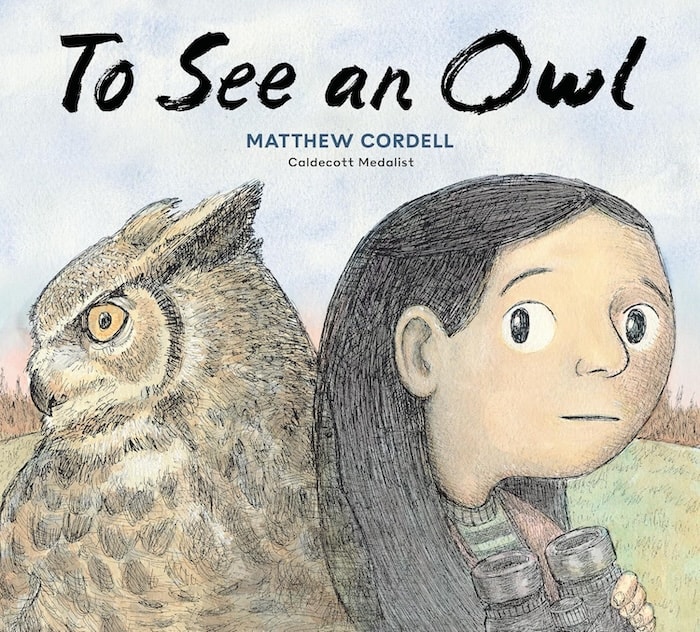
To See an Owl
Written by Matthew Cordell
Illustrated by Matthew Cordell
A young girl is determined to see an owl — a real one, in the wild. With her father by her side, she ventures out into the woods at dusk, waiting and watching with all the patience she can muster. From Caldecott Medalist Matthew Cordell, this tender story celebrates the quiet thrill of nature, the bond between parent and child, and the magic of finally seeing something you've been hoping for.
From the Library Director
Matthew Cordell is at his best here — warm, funny, and deeply observant. To See an Owl is a perfect read-aloud for any unit on nature, perseverance, or family relationships. The illustrations capture that particular quality of light just before dark, and the ending is genuinely satisfying. A wonderful companion to any outdoor exploration activity.
Big Idea
Some of the most wonderful things in life require patience, stillness, and the willingness to simply wait and watch.
Discussion Questions
- 1
Why does the girl want to see an owl so badly? What does she do to try to make it happen?
- 2
Have you ever waited a long time for something you really wanted? How did it feel while you were waiting? How did it feel when it finally happened — or didn't?
- 3
The girl and her father go out into the woods together. What does their relationship feel like? How does Matthew Cordell show it without saying it directly?
- 4
What does it mean to be patient? Is patience easy or hard for you? When is it hardest?
- 5
Look at the illustrations of the woods at dusk. What details do you notice? How does the light and color change as the story goes on?
- 6
Why do you think the author chose an owl for this story? What is special or mysterious about owls?
- 7
Have you ever seen a wild animal in nature — really seen one, up close? What happened? How did it make you feel?
- 8
At the end of the story, the girl finally sees the owl. Why does that moment feel so powerful? What made the waiting worth it?
Activity: The Waiting Journal
Students explore patience, observation, and the natural world through a reflective writing and drawing activity inspired by the book.
- 1
Before reading, ask students: Have you ever tried really hard to see or find something in nature? What happened? Record a few responses.
- 2
Read To See an Owl aloud, pausing to let students look closely at the illustrations — especially the changing light and the details of the forest.
- 3
Discuss: What did the girl have to do to finally see the owl? Make a list on the board: go outside, be quiet, be still, wait, look carefully, try again.
- 4
Students create a 'Waiting Journal' entry: draw something in nature they would love to see (a deer, a firefly, a shooting star, a rainbow), and write two sentences — one about what they would do to try to see it, and one about how they would feel if they finally did.
- 5
Share entries with the class. Discuss: What do all our 'waiting' experiences have in common? What does this story teach us about patience, hope, and paying attention to the world around us?
Standards Connections
CCSS.ELA-LITERACY.RL.K-3.3 — Describe characters and explain how their actions contribute to the sequence of events
CCSS.ELA-LITERACY.RL.K-3.4 — Determine the meaning of words and phrases as they are used in a text
CCSS.ELA-LITERACY.W.K-3.3 — Write narratives using descriptive details and temporal words to signal event order
NGSS K-LS1-1 — Use observations to describe patterns of what plants and animals need to survive
SEL — Self-Management: Demonstrate patience and persistence in working toward a goal
SEL — Social Awareness: Show appreciation for the natural world and the relationships within it
Ready to use this guide in your classroom?
Download the printable PDF with all questions and activities.