
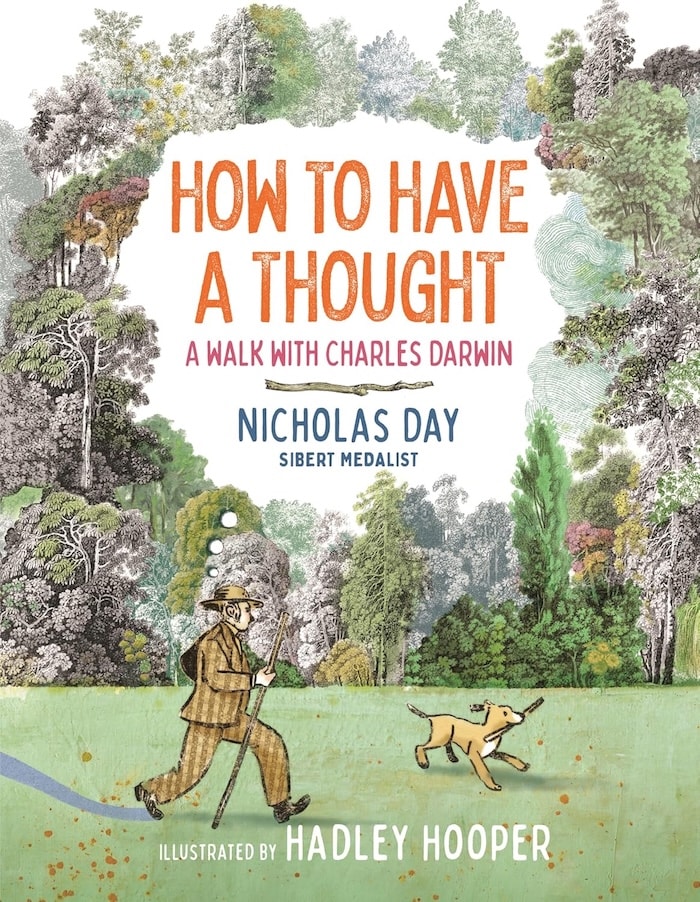
How to Have a Thought
A Walk with Charles Darwin
Written by Nicholas Day
Illustrated by Hadley Hooper
Every day, Charles Darwin took a walk. Not just any walk — a thinking walk. Along his Sandwalk path at Down House, he would pace and ponder, letting his mind wander until ideas began to take shape. In this Sibert Medal-winning picture book, Nicholas Day and Hadley Hooper reveal how Darwin's greatest scientific breakthroughs grew not from a laboratory, but from the simple, radical act of walking and wondering. A beautiful invitation for young thinkers to slow down, look closely, and let their minds roam.
From the Library Director
This is a genuinely special book — quiet, thoughtful, and intellectually rich in a way that respects young readers. Nicholas Day has written something that feels almost like a meditation on how thinking works, anchored in Darwin's real daily practice. Hadley Hooper's illustrations are extraordinary: layered, detailed, and full of the same patient observation Darwin himself practiced. A Sibert Medal winner and an essential addition to any library collection. Perfect for science units, biography studies, or any conversation about how ideas are born.
Big Idea
Great ideas don't always arrive in a flash — sometimes they grow slowly, one step at a time, when we give ourselves the space to wonder.
Discussion Questions
- 1
Charles Darwin walked the same path every day to help himself think. Why do you think walking helped him have ideas? Does moving your body ever help you think?
- 2
Darwin was very patient — he thought about the same questions for years before he had answers. Is it hard to be patient with a big question? What helps you keep thinking when you don't have an answer yet?
- 3
Darwin noticed things that other people walked right past. What is something small or ordinary that you have noticed and wondered about? What questions did it give you?
- 4
The book is called How to Have a Thought. What do you think that means? Can you 'practice' having thoughts, the way you practice a sport or an instrument?
- 5
Darwin's Sandwalk was his special thinking place. Do you have a place where you do your best thinking? What makes it good for thinking?
- 6
Look closely at Hadley Hooper's illustrations. What details do you notice? How does the art style match the way Darwin thought about the world?
- 7
Darwin's ideas changed the way humans understand life on Earth. But he started with very small observations — a beetle, a worm, a finch. How can small observations lead to big ideas?
- 8
If you could take a thinking walk with Charles Darwin, what question would you want to think about together?
Activity: The Thinking Walk
Students practice Darwin's method of slow, patient observation and wondering through a guided outdoor (or indoor) thinking walk and a reflection activity.
- 1
Before reading, ask students: Where do you do your best thinking? What helps you get ideas? Record a few answers. Then introduce Darwin: he walked the same path every day, on purpose, to think. What do students predict about why that worked?
- 2
Read How to Have a Thought aloud. After reading, discuss: What did Darwin actually do on his walks? What was he looking for? What did he find? How long did it take for his ideas to become fully formed?
- 3
Take a class 'Thinking Walk' — outside if possible, or slowly around the school building. Give each student a small notebook. Their only job: notice things. Not big things. Small things. A crack in the pavement. A shadow. A sound. A smell. Write or draw at least three observations.
- 4
Back in the classroom, students choose one observation and write two questions it gives them — things they genuinely wonder about. Share questions with the class. Discuss: Which questions could you investigate? Which might take years to answer? Which might never have an answer?
- 5
Reflect: How did it feel to walk slowly and notice? Was it easy or hard to slow down? What did you see that you normally walk past? Connect back to Darwin: this is exactly what he did, every day, for decades. What does that tell us about how science really works?
Standards Connections
CCSS.ELA-LITERACY.RI.K-3.3 — Describe the connection between a series of historical events, scientific ideas, or steps in a technical procedure
CCSS.ELA-LITERACY.RI.K-3.6 — Distinguish their own point of view from that of the author of a text
NGSS K-2-ETS1-1 — Ask questions, make observations, and gather information about a situation people want to change
NGSS 3-5-ETS1-1 — Define a simple design problem reflecting a need or want that includes criteria for success
SEL — Self-Awareness: Develop the ability to slow down, reflect, and engage in sustained thinking about questions that matter
Library & Information Literacy — Understand that scientific knowledge develops through patient observation, questioning, and revision over time
Ready to use this guide in your classroom?
Download the printable PDF with all questions and activities.