
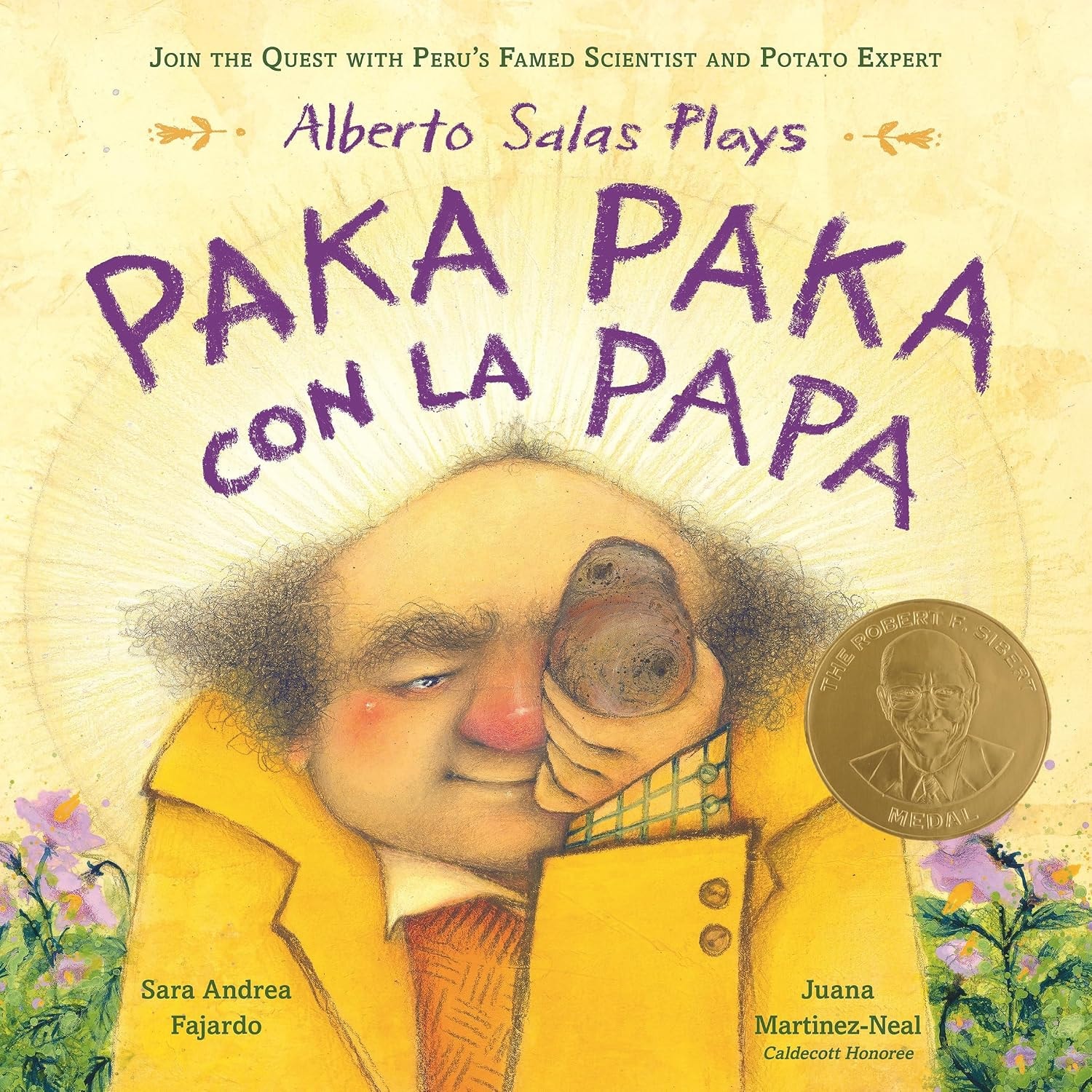
Alberto Salas Plays Paka Paka con la Papa
Join the Quest with Peru's Famed Scientist and Potato Expert
Written by Sara Andrea Fajardo
Illustrated by Sara Andrea Fajardo
Alberto Salas was a Peruvian scientist who dedicated his life to studying and preserving the potato — one of the world's most important foods — in all its astonishing variety. In this vibrant, playful picture book, Sara Andrea Fajardo brings Alberto's quest to life through the traditional Peruvian children's game Paka Paka, inviting young readers to join the search for potatoes across the Andes. Bursting with color, culture, and scientific wonder, this is a joyful celebration of biodiversity, indigenous knowledge, and one man's extraordinary love for a humble vegetable.
From the Library Director
This book is a genuine discovery. Sara Andrea Fajardo has done something remarkable: she's woven together a biography, a science lesson, a cultural celebration, and a children's game into a single joyful picture book. Alberto Salas is not a household name, but he should be — and this book makes a compelling case for why. The potato biodiversity angle is genuinely fascinating, and the Paka Paka game structure gives the whole thing an irresistible energy. A wonderful addition to any collection, especially for units on food systems, South American cultures, or scientists who changed the world quietly.
Big Idea
Science can grow from love — love for your culture, your land, and the living things that feed the world.
Discussion Questions
- 1
Alberto Salas spent his life studying potatoes. Why do you think potatoes were so important to him? Why might potatoes be important to the whole world?
- 2
The book is structured like the game Paka Paka. Have you ever played a searching or hiding game? How did the game make you feel about the story?
- 3
Alberto found hundreds of different kinds of potatoes. Did you know there were so many varieties? Why do you think it matters that we have many different kinds of the same food?
- 4
Alberto's work was about preserving something — making sure it wasn't lost. What does it mean to preserve something? Can you think of other things people work to preserve?
- 5
The potato originally came from Peru and the Andes. How do you think it spread to the rest of the world? What does that tell us about how food connects people across cultures?
- 6
Alberto used both scientific knowledge and traditional Peruvian knowledge in his work. Why is it important to value both kinds of knowledge?
- 7
Look at the illustrations. What colors, patterns, and details do you notice? How does the art reflect Peruvian culture?
- 8
If you were a scientist like Alberto, what plant or animal would you want to spend your life studying? Why?
Activity: The Potato Diversity Map
Students explore the concept of biodiversity through the lens of the potato — one of the world's most diverse and important crops — and connect Alberto Salas's scientific work to their own food experiences.
- 1
Before reading, ask students: What do you know about potatoes? How many kinds of potatoes can you name? Record answers. Then ask: Did you know there are over 4,000 varieties of potato? Where do students think they all come from? Introduce Peru and the Andes as the potato's homeland.
- 2
Read Alberto Salas Plays Paka Paka con la Papa aloud. After reading, discuss: What was Alberto's job? Why did he think it was important? What would happen if all the different kinds of potatoes disappeared and only one kind was left?
- 3
Introduce the concept of biodiversity: having many different varieties of a plant or animal. Discuss why biodiversity matters — different varieties have different strengths (some resist disease, some grow in cold climates, some store better). Connect to the Irish Potato Famine as an example of what can happen when a crop lacks diversity (age-appropriate overview).
- 4
Students create a 'Potato Diversity Map': draw or label a world map showing where potatoes originated (Peru/Andes) and where they spread. Around the map, draw or write 4–6 different potato varieties they can research (Yukon Gold, Purple Peruvian, Fingerling, Russet, Red Bliss, etc.). Add one fact about each variety.
- 5
Bring in 2–3 different real potato varieties if possible. Students observe and compare: color, size, shape, texture. Discuss: How are they different? How are they the same? What might each one be good for? Connect back to Alberto: this is exactly the kind of careful observation he did his whole life.
Standards Connections
CCSS.ELA-LITERACY.RI.K-3.3 — Describe the connection between a series of historical events, scientific ideas, or steps in a technical procedure
CCSS.ELA-LITERACY.RI.K-3.7 — Use information gained from illustrations and words in a text to demonstrate understanding of the text
NGSS K-LS1-1 — Use observations to describe patterns of what plants and animals need to survive
NGSS 3-LS4-4 — Make a claim about the merit of a solution to a problem caused when the environment changes and the types of plants and animals that live there may change
Social Studies — Culture: Understand how cultural practices and traditions are connected to the natural environment and food systems
SEL — Social Awareness: Recognize and appreciate the contributions of individuals from diverse cultural backgrounds to science and human knowledge
Ready to use this guide in your classroom?
Download the printable PDF with all questions and activities.