
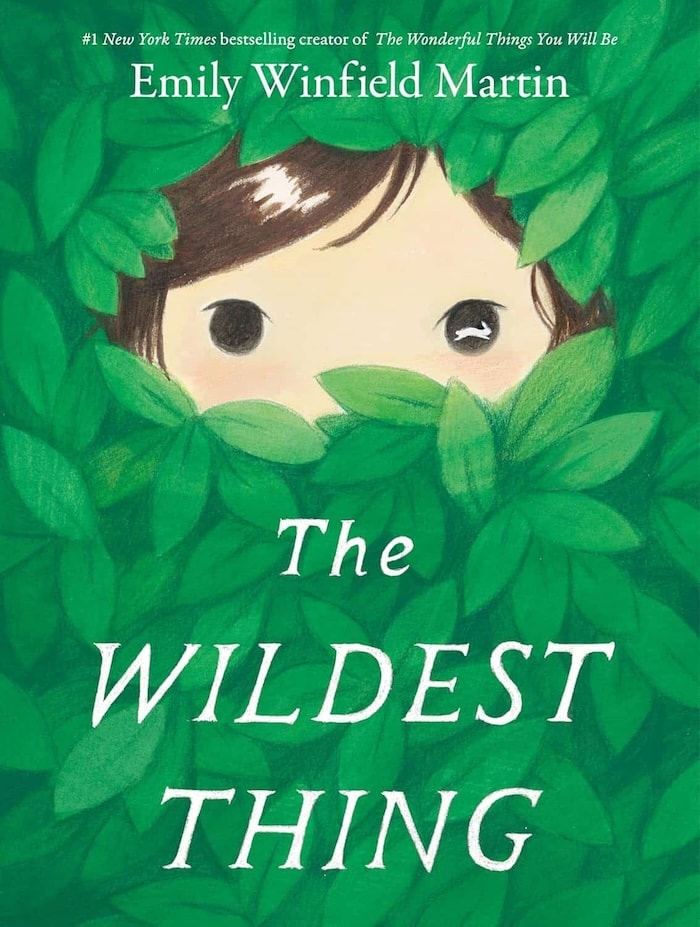
The Wildest Thing
Written & illustrated by Emily Winfield Martin
What is the wildest thing? It isn't a lion or a storm or a deep dark wood. The wildest thing is something that lives inside every child — a feeling, a dream, a spark of imagination that can't be tamed. In this lyrical, luminous picture book, Emily Winfield Martin weaves together stunning art and poetic text to celebrate the untameable inner world of childhood. A love letter to the wild, wondering minds of young readers everywhere.
From the Library Director
Emily Winfield Martin is one of the most distinctive voices in picture books today, and The Wildest Thing is her at her most purely herself. The art is extraordinary — rich, layered, dreamlike — and the text has the quality of a poem you want to read aloud slowly, savoring every word. This is a book that doesn't explain itself, and that's exactly right. It trusts children to feel it rather than decode it. A perfect read-aloud for any conversation about imagination, feelings, or what it means to be alive and curious. Essential for any PreK–2 collection.
Big Idea
The wildest, most powerful thing in the world isn't something out there — it's the imagination and feeling that lives inside you.
Discussion Questions
- 1
What do you think the 'wildest thing' is in this book? Did the answer surprise you? What did you expect it to be?
- 2
The book says the wildest thing lives inside you. What does that mean? Can you describe what your own 'wildest thing' feels like?
- 3
Look at the illustrations. What do you notice? What colors, creatures, and places do you see? How does the art make you feel?
- 4
The text in this book sounds almost like a poem. What words or phrases stood out to you? Why?
- 5
Have you ever felt something so big and exciting inside you that it was hard to describe? What was happening? What did it feel like?
- 6
Why do you think the author chose the word 'wild' to describe imagination and feelings? What other words could she have used? Why is 'wild' a good choice?
- 7
The book celebrates things that can't be tamed or controlled. Is that a good thing or a scary thing? Can you think of times when being 'untamed' is wonderful, and times when it might be hard?
- 8
If you could draw your own 'wildest thing,' what would it look like? What colors would you use? What creatures or places would be in it?
Activity: My Wildest Thing
Students explore their own inner imaginative world through a guided art and writing activity inspired by Emily Winfield Martin's lyrical, dreamlike approach.
- 1
Before reading, ask students: What is the wildest animal you can think of? What is the wildest place? Record answers. Then ask: Could something inside a person be wild? What might that look like? Let students wonder aloud before introducing the book.
- 2
Read The Wildest Thing aloud slowly, pausing to let students look at each spread. After reading, sit in silence for a moment. Then ask: What are you thinking right now? What did the book make you feel? Don't rush to discussion — let the quiet do some work first.
- 3
Discuss: What was the wildest thing in the book? Did it surprise you? What does it mean that imagination and feeling are 'wild'? Can you tame a feeling? Should you? What happens when you try?
- 4
Students create their own 'Wildest Thing' artwork: a full-page illustration of what their inner wild world looks like. Encourage them to fill the page with color, creatures, landscapes, and anything that feels true to their imagination. No rules — the wilder the better. Provide watercolors, colored pencils, or crayons.
- 5
Students add a one-sentence caption to their artwork: 'My wildest thing is ___.' Share with the class. Display as a gallery. Discuss: What do all our wildest things have in common? What makes each one unique? What does it tell us about our class that we all have wild things inside us?
Standards Connections
CCSS.ELA-LITERACY.RL.K-2.4 — Ask and answer questions about unknown words in a text; identify words and phrases that suggest feelings or appeal to the senses
CCSS.ELA-LITERACY.RL.K-2.7 — Use information gained from illustrations and words in a text to demonstrate understanding of the text
CCSS.ELA-LITERACY.W.K-2.3 — Use a combination of drawing, dictating, and writing to narrate a single event or several loosely linked events
Visual Arts — Creating: Generate and conceptualize artistic ideas and work; organize and develop artistic ideas and work
SEL — Self-Awareness: Identify and describe one's own emotions, thoughts, and values; recognize personal strengths and areas for growth
SEL — Self-Management: Demonstrate the ability to manage one's emotions and thoughts; develop a growth mindset and sense of agency
Ready to use this guide in your classroom?
Download the printable PDF with all questions and activities.