
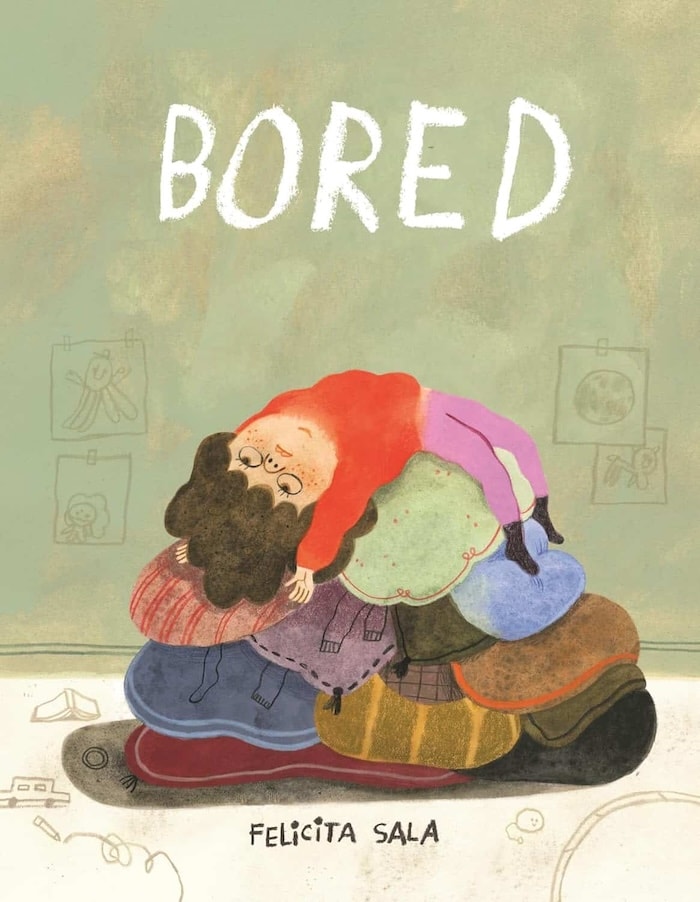
Bored
Written & illustrated by Felicita Sala
Three children are bored. Deeply, thoroughly, magnificently bored. But boredom, it turns out, is not an ending — it's a beginning. In this gorgeous, quietly funny picture book, Felicita Sala follows what happens when children are left alone with nothing to do and everything to imagine. With her signature warm, earthy watercolors and a gentle, unhurried pace, Sala makes a tender case for the creative power of doing nothing at all.
From the Library Director
Felicita Sala is one of the most visually distinctive illustrators working in picture books today, and Bored is a perfect showcase for everything that makes her special. The palette is muted and warm, the children are wonderfully lumpy and real, and the whole book has a kind of slow, dreamy quality that mirrors its subject perfectly. This is a book that trusts children — and the adults reading with them — to sit with a feeling rather than rush past it. In an era of overscheduled childhoods and constant stimulation, Bored is a genuinely radical act. Essential.
Big Idea
Boredom isn't something to fix — it's the doorway to imagination, creativity, and the best kind of play.
Discussion Questions
- 1
Have you ever felt really, truly bored? What did it feel like? What did you end up doing?
- 2
The children in the book start out bored but end up doing something wonderful. What happened? How did boredom turn into something good?
- 3
Why do you think the author made a whole book about being bored? What is she trying to tell us about boredom?
- 4
Look at the illustrations. What do you notice about the colors and the way the children look? How does the art make you feel?
- 5
Some people say boredom is bad and we should always be doing something. Do you agree? Can boredom ever be a good thing?
- 6
The children don't use screens or toys to fix their boredom. What do they use instead? What does that tell us about imagination?
- 7
Have you ever invented a game, a story, or a world out of nothing — just because you had nothing else to do? What was it?
- 8
If you had a whole afternoon with nothing planned and no screens allowed, what do you think you might end up doing? What might you discover?
Activity: The Boredom Experiment
Students experience a structured version of unstructured time — and discover what their own imaginations produce when given space to roam.
- 1
Before reading, ask students: What do you do when you're bored? What does boredom feel like in your body? Is it uncomfortable? Record answers. Then ask: Is boredom always bad? Could it ever be useful? Let students debate briefly before introducing the book.
- 2
Read Bored aloud slowly, pausing on each spread to look at the illustrations together. After reading, discuss: What happened to the children's boredom? What did they create? Did the book surprise you? What did you expect to happen?
- 3
Introduce the idea of 'creative boredom': researchers have found that when our brains aren't busy, they start making connections, inventing stories, and solving problems in new ways. Boredom is actually when some of our best thinking happens. Ask: Does that match your experience? Can you think of a time when you got a great idea when you were doing nothing?
- 4
The Boredom Experiment: give students 10 minutes of completely unstructured time. No instructions, no prompts, no screens. They can draw, write, stare out the window, build something with whatever is on their desk, or do absolutely nothing. The only rule: no asking what to do. Observe what happens.
- 5
After the experiment, students write or draw one thing they thought about, invented, or noticed during their boredom time. Share with the class. Discuss: What surprised you? Did anyone have an idea they want to keep working on? Connect back to the book: this is exactly what happened to the children in Bored. What does that tell us about what our brains can do when we let them wander?
Standards Connections
CCSS.ELA-LITERACY.RL.K-2.3 — Describe characters in a story and explain how their actions contribute to the sequence of events
CCSS.ELA-LITERACY.RL.K-2.7 — Use information gained from illustrations and words in a text to demonstrate understanding of the text
CCSS.ELA-LITERACY.W.K-2.3 — Use a combination of drawing, dictating, and writing to narrate a single event or several loosely linked events
Visual Arts — Responding: Interpret intent and meaning in artistic work; relate artistic ideas and works to societal, cultural, and historical contexts
SEL — Self-Management: Demonstrate the ability to manage one's emotions and thoughts; develop strategies for coping with discomfort and uncertainty
SEL — Responsible Decision-Making: Identify solutions to personal and social problems; reflect on and evaluate the results of one's own choices
Ready to use this guide in your classroom?
Download the printable PDF with all questions and activities.