
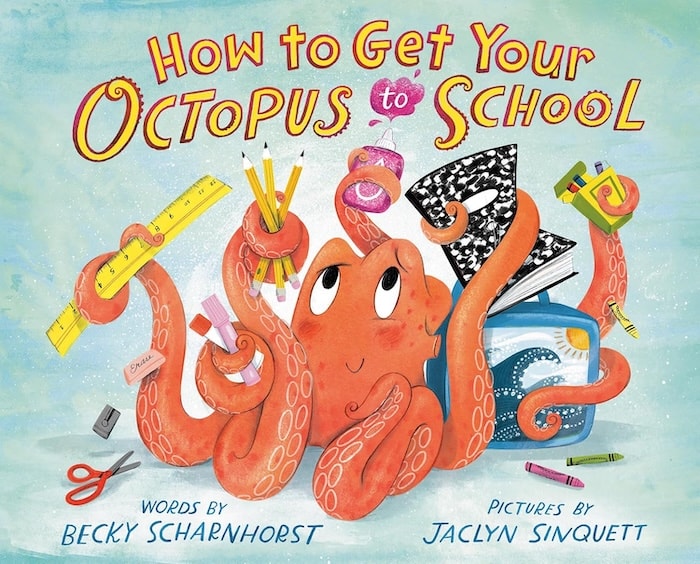
How to Get Your Octopus to School
Written by Becky Scharnhorst
Illustrated by Jaclyn Sinquett
Getting ready for school is hard enough — but what if your pet is an octopus? With eight arms to dress, eight sets of supplies to pack, and a very particular opinion about everything, this octopus is going to make the morning routine a true adventure. Becky Scharnhorst's hilarious, warmhearted text pairs perfectly with Jaclyn Sinquett's exuberant illustrations to create a back-to-school book that celebrates the beautiful chaos of new beginnings — and the friends (and cephalopods) who make it all worthwhile.
From the Library Director
How to Get Your Octopus to School is exactly the kind of book that makes kids fall in love with reading. It's genuinely funny — not in a winking, adult-joke way, but in a pure, delighted, 'read it again' way that children respond to immediately. Becky Scharnhorst has a gift for absurdist humor that never loses its heart, and Jaclyn Sinquett's illustrations are an absolute joy — packed with detail, color, and personality. A perfect back-to-school read-aloud, and a wonderful companion to any conversation about new beginnings, friendship, and the first day jitters. Essential for any PreK–2 collection.
Big Idea
Starting something new is a little scary and a lot exciting — and it's always better with a friend by your side (even if that friend has eight arms).
Discussion Questions
- 1
Why is it so funny that the child has an octopus for a pet? What makes an octopus a silly choice for school? What would be the hardest part of bringing an octopus to school?
- 2
The octopus needs a lot of help getting ready. What are some of the things the child has to do for the octopus? Have you ever had to help someone get ready for something?
- 3
Have you ever felt nervous about starting something new — like a new school year, a new class, or a new activity? What did it feel like? What helped?
- 4
The octopus has eight arms. How does that make things harder — and how might it make things easier? Can you think of ways having eight arms would actually be helpful at school?
- 5
What do you think the other kids at school think when they see the octopus? How do you think the octopus feels on the first day?
- 6
The book is a 'how to' guide. What other 'how to' books can you think of? What would you write a 'how to' guide about?
- 7
What is your morning routine before school? What steps do you have to do? What would happen if you had to do all those steps for an octopus too?
- 8
At the end of the book, how do the child and the octopus feel? What does the story tell us about trying new things and making friends?
Activity: How to Get Your _______ to School
Students create their own 'How to Get Your [Animal] to School' mini-book, practicing sequencing, procedural writing, and illustration — all through the lens of absurdist humor.
- 1
Before reading, ask students: What would be the most ridiculous animal to bring to school? Take a few suggestions and enjoy the silliness. Then introduce the book: someone already wrote a book about this! Let's see which animal they chose.
- 2
Read How to Get Your Octopus to School aloud. After reading, discuss: What steps did the child have to follow? Why was each step funny? What made the octopus so hard to get ready? What made it worth it in the end?
- 3
Introduce procedural writing: a 'how to' text gives instructions in order, using sequence words like first, next, then, and finally. Look back at the book together — can students identify the sequence words and steps? How does the author make each step funny?
- 4
Students choose their own animal and create a 4-page 'How to Get Your _______ to School' mini-book. Each page covers one step: getting dressed, packing supplies, eating breakfast, and arriving at school. Students write one sentence per page and illustrate it. Encourage them to think about what makes their animal funny — too big? Too many legs? Too sleepy? Too loud?
- 5
Share mini-books with the class or a partner. Display them as a class collection. Discuss: What did all our animals have in common? What made each one unique? What does it feel like to write something funny? Connect back to the book: Becky Scharnhorst had to think of all these funny details too — that's what writers do.
Standards Connections
CCSS.ELA-LITERACY.RL.K-2.3 — Describe characters in a story and explain how their actions contribute to the sequence of events
CCSS.ELA-LITERACY.RL.K-2.6 — Identify who is telling the story at various points in a text; distinguish own point of view from that of the narrator or characters
CCSS.ELA-LITERACY.W.K-2.2 — Use a combination of drawing, dictating, and writing to compose informative/explanatory texts that introduce a topic and supply information
CCSS.ELA-LITERACY.W.K-2.3 — Use a combination of drawing, dictating, and writing to narrate a single event or several loosely linked events in sequence
SEL — Self-Management: Demonstrate the ability to manage one's emotions and thoughts in anticipation of new or challenging situations
SEL — Relationship Skills: Demonstrate the ability to establish and maintain healthy and rewarding connections; show care and concern for others
Ready to use this guide in your classroom?
Download the printable PDF with all questions and activities.