
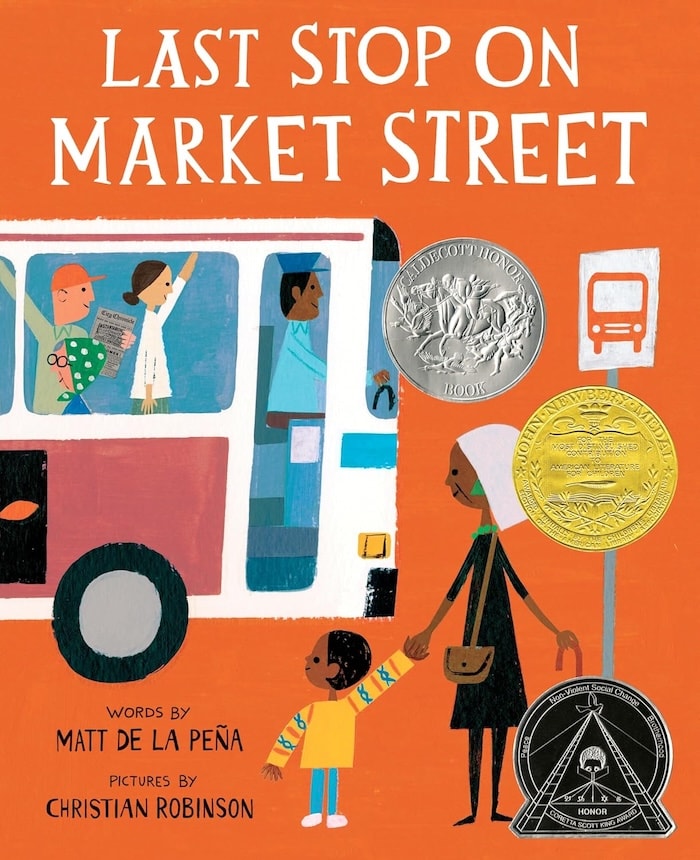
Last Stop on Market Street
Written by Matt de la Peña
Illustrated by Christian Robinson
Every Sunday after church, CJ and his Nana ride the bus across town to volunteer at a soup kitchen. But CJ has questions — why don't they have a car like his friend? Why do they always have to go to the bad part of town? Why can't he have an iPod? With gentle wisdom and quiet joy, Nana helps CJ see the beauty and richness all around him — in the music of a blind man's guitar, the colors of the city, the faces of strangers on the bus. By the time they reach the last stop on Market Street, CJ understands something profound: beauty is everywhere, if you know how to look. Winner of the Newbery Medal, Caldecott Honor, and Coretta Scott King Honor.
From the Library Director
Last Stop on Market Street is one of the most important picture books of the last decade, and it earns every one of its awards. Matt de la Peña writes with a poet's ear — every line is precise, musical, and emotionally true. Christian Robinson's illustrations are a masterclass in color and composition: bold, joyful, and full of the kind of visual storytelling that rewards repeated reading. What makes this book extraordinary is that it never lectures. CJ's questions are real children's questions, and Nana's answers are never preachy — they're wise and warm and full of love. This is the book you reach for when you want to talk about gratitude, community, service, and the art of noticing. Essential for every K–3 collection, and one of the rare picture books that works just as well with fifth graders as with kindergarteners.
Big Idea
Gratitude isn't about what you have — it's about how you see. When we look for beauty and meaning in the world around us, we find it everywhere.
Discussion Questions
- 1
CJ asks Nana a lot of questions on the bus ride. What are some of the things he wonders about? Why do you think he's asking these questions?
- 2
Nana answers CJ's questions in a special way — she doesn't just say 'because' or 'that's just how it is.' How does she help him see things differently? Can you think of an example?
- 3
CJ wishes he had an iPod like his friend Colby. Have you ever wished you had something someone else had? How did that feel? What did Nana say to help CJ feel differently?
- 4
On the bus, CJ meets a blind man who plays guitar. What does the blind man say about how he 'sees' the world? What do you think he means?
- 5
CJ and Nana are going to volunteer at a soup kitchen. Why do you think Nana takes CJ there every Sunday? What do you think CJ learns from going?
- 6
At the end of the book, CJ says the soup kitchen is 'beautiful.' What changed? Did the place change, or did CJ change? What made the difference?
- 7
Nana says, 'Sometimes when you're surrounded by dirt, CJ, you're a better witness for what's beautiful.' What do you think she means? Can you think of a time you found something beautiful in an unexpected place?
- 8
This book is about a bus ride, but it's really about something much bigger. What do you think the book is really about? What is the most important thing CJ learns?
Activity: A Gratitude Walk
Students practice the art of noticing — finding beauty, interest, and meaning in the everyday world around them, just as CJ learns to do on the bus.
- 1
Before reading, ask students: What is gratitude? Is it the same as saying 'thank you'? Can you be grateful for something without saying it out loud? Take a few responses. Then ask: Have you ever noticed something beautiful or interesting that you almost walked right past? Introduce the idea that gratitude starts with noticing.
- 2
Read Last Stop on Market Street aloud, pausing to look closely at Christian Robinson's illustrations. After reading, discuss: What did CJ notice by the end of the book that he didn't notice at the beginning? What changed? How did Nana help him see differently? What does it mean to be a 'witness for what's beautiful'?
- 3
Introduce the concept of a gratitude walk: a slow, intentional walk where the goal is to notice — not to get somewhere, but to really look. Discuss: What's the difference between walking somewhere and really noticing where you are? What might you see if you slowed down and paid attention to your school, your neighborhood, your classroom?
- 4
Take students on a 10–15 minute gratitude walk around the school building or grounds. Give each student a small notebook or index card. Their job: find and record (in words or quick sketches) five things they notice that they've never really looked at before — a texture, a color, a sound, a smell, a person doing something kind. Encourage them to look up, down, and sideways.
- 5
Back in the classroom, students share one thing they noticed. Compile a class 'gratitude map' — a large paper map of the school with students' observations marked on it. Discuss: Were you surprised by what you noticed? Did anyone find something beautiful in an unexpected place? Connect back to CJ: this is exactly what Nana was teaching him to do. Close with the question: How might your day be different if you walked through it like this every day?
Standards Connections
CCSS.ELA-LITERACY.RL.K-3.3 — Describe characters in a story and explain how their actions contribute to the sequence of events
CCSS.ELA-LITERACY.RL.K-3.4 — Identify words and phrases in stories or poems that suggest feelings or appeal to the senses
CCSS.ELA-LITERACY.RL.K-3.6 — Identify the point of view of the narrator and how it shapes the story
CCSS.ELA-LITERACY.W.K-3.3 — Write narratives in which they recount a well-elaborated event or short sequence of events, include details to describe actions, thoughts, and feelings
SEL — Self-Awareness: Identify and describe one's own emotions; practice gratitude as a tool for emotional regulation and positive outlook
SEL — Social Awareness: Demonstrate empathy and compassion; recognize the value of community service and helping others
Ready to use this guide in your classroom?
Download the printable PDF with all questions and activities.